WIREFRAMES
Making Spatial thinking effortless by turning complexity into flow.
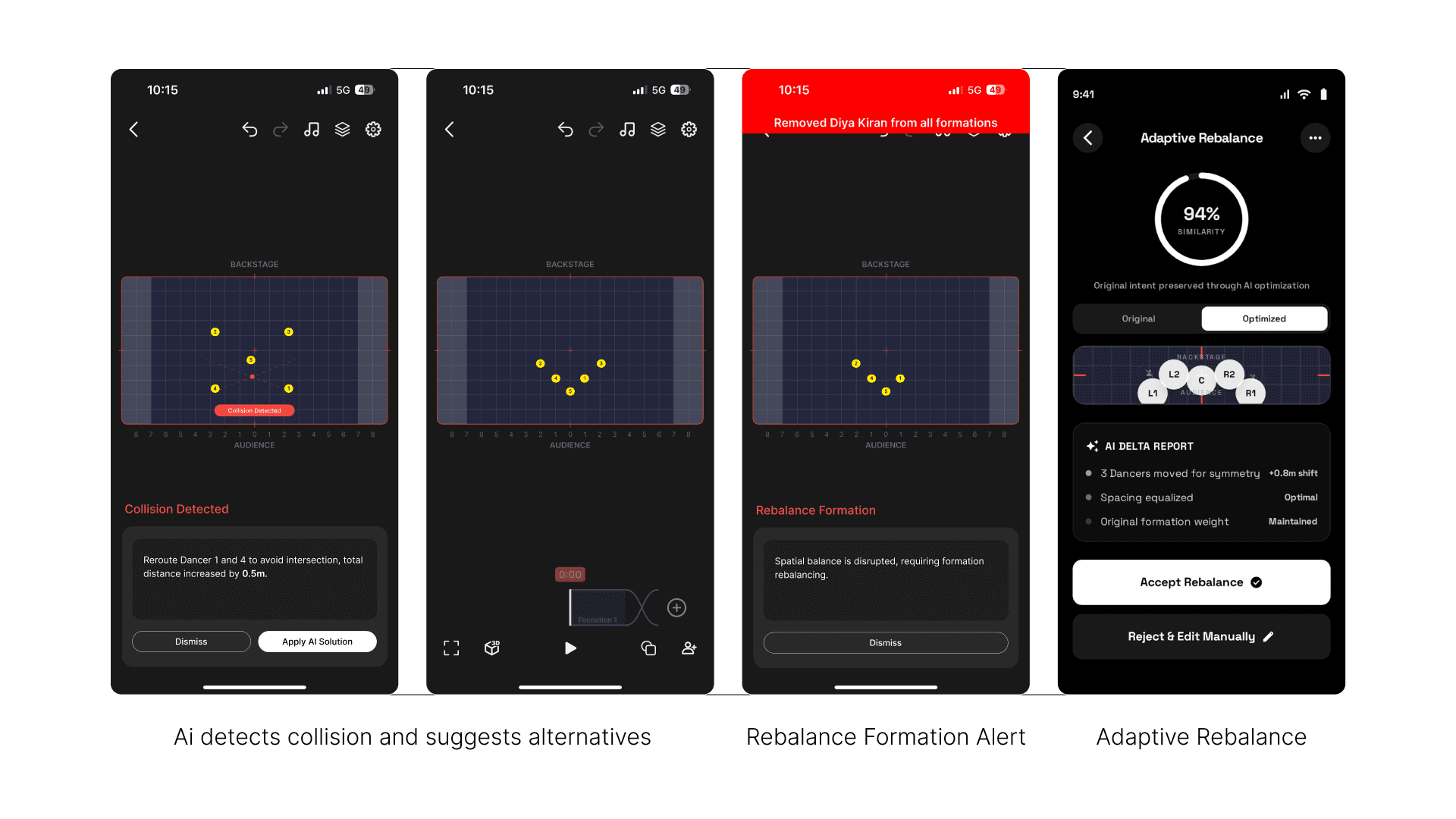
Wireframes focused on enabling choreographers to think in motion visualizing formations, timing shifts, and transitions instantly, while AI handled precision, collisions, and balance in the background.

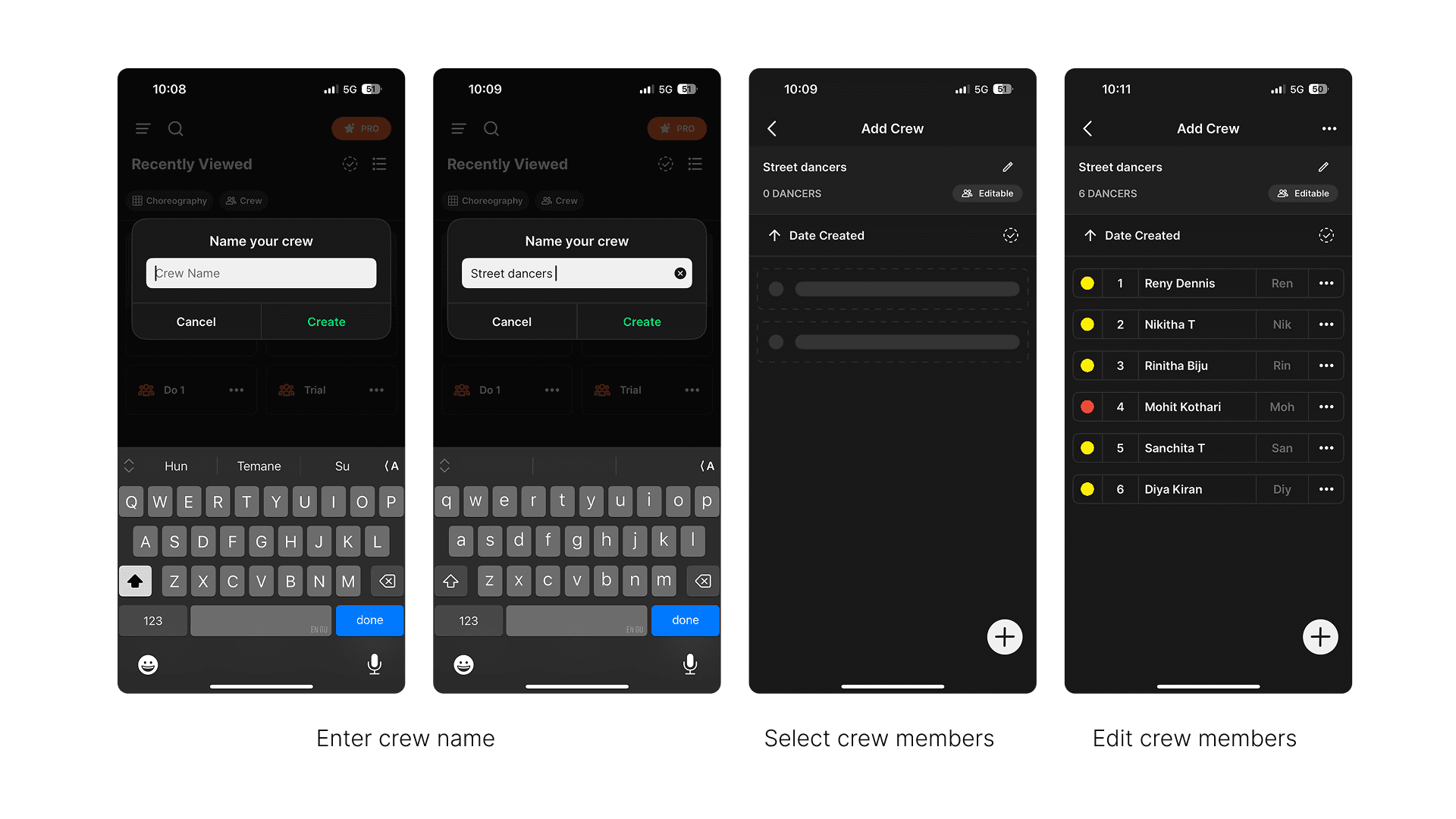
Name your squad to unlock the choreography suite
Onboard dancers manually or via a quick-share signup link.
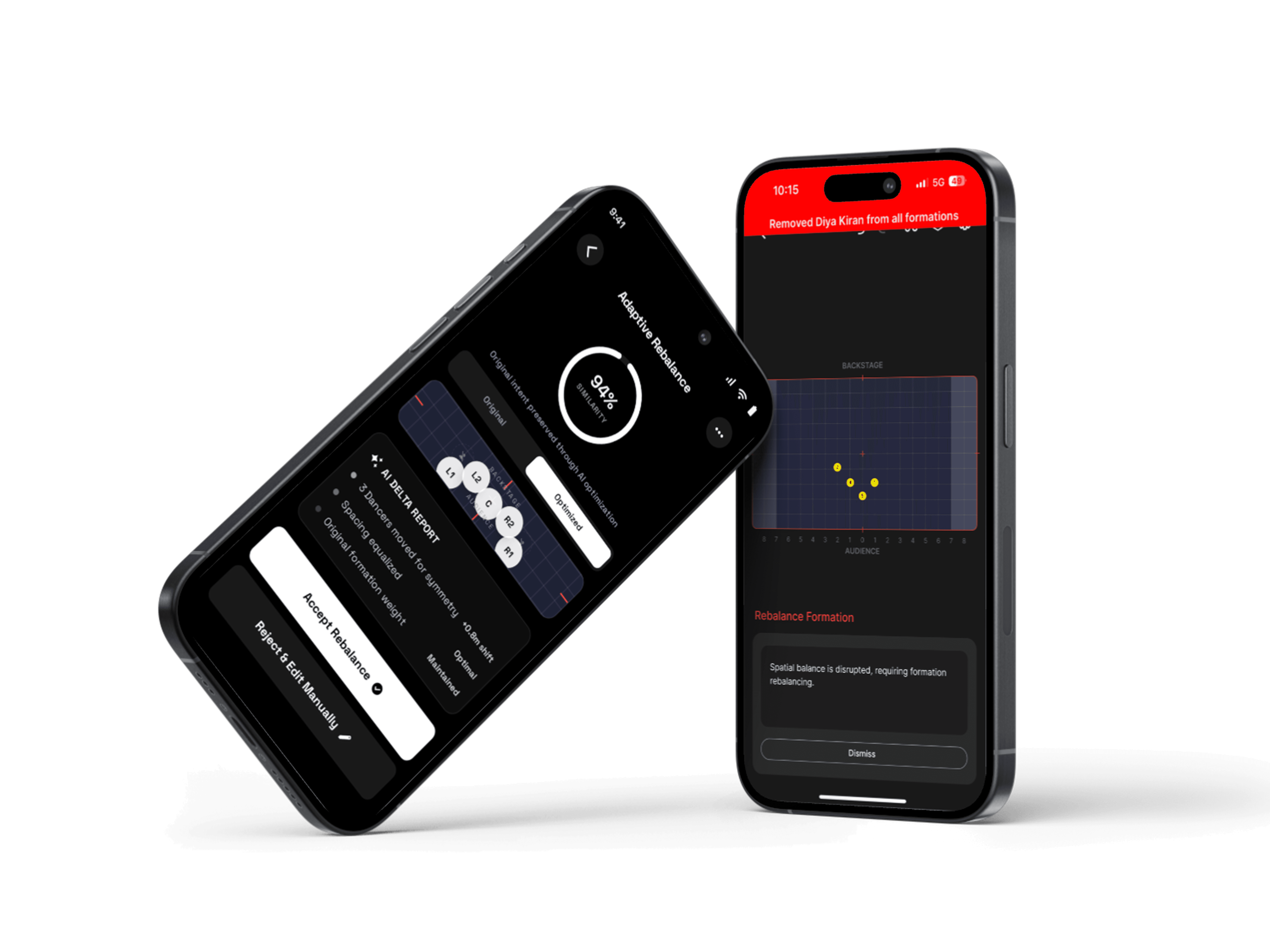
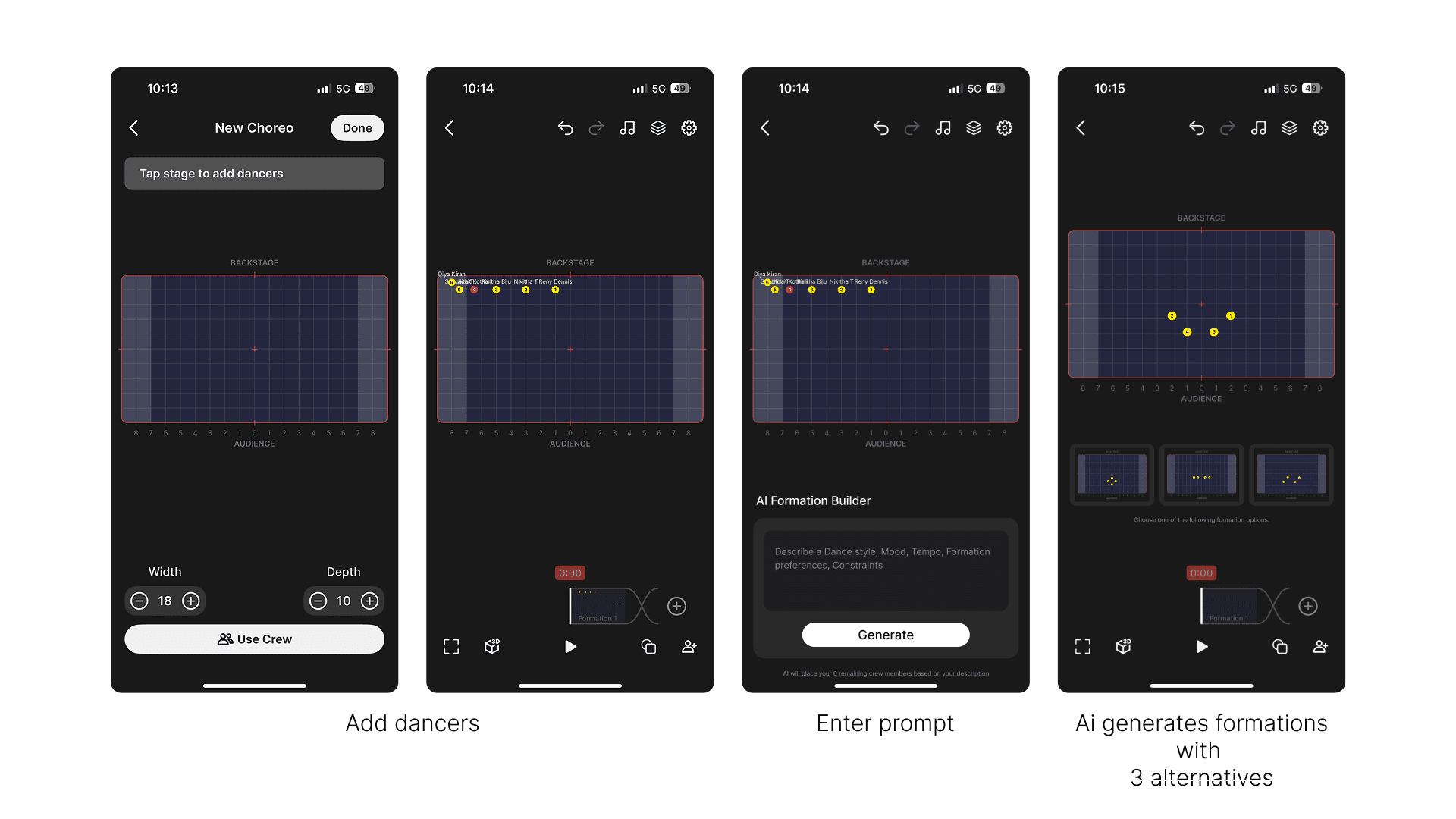
Generate instant staging variations with our intelligent layout engine
Detect movement overlaps and fix pathing issues with one tap
Maintain visual symmetry automatically when your roster changes
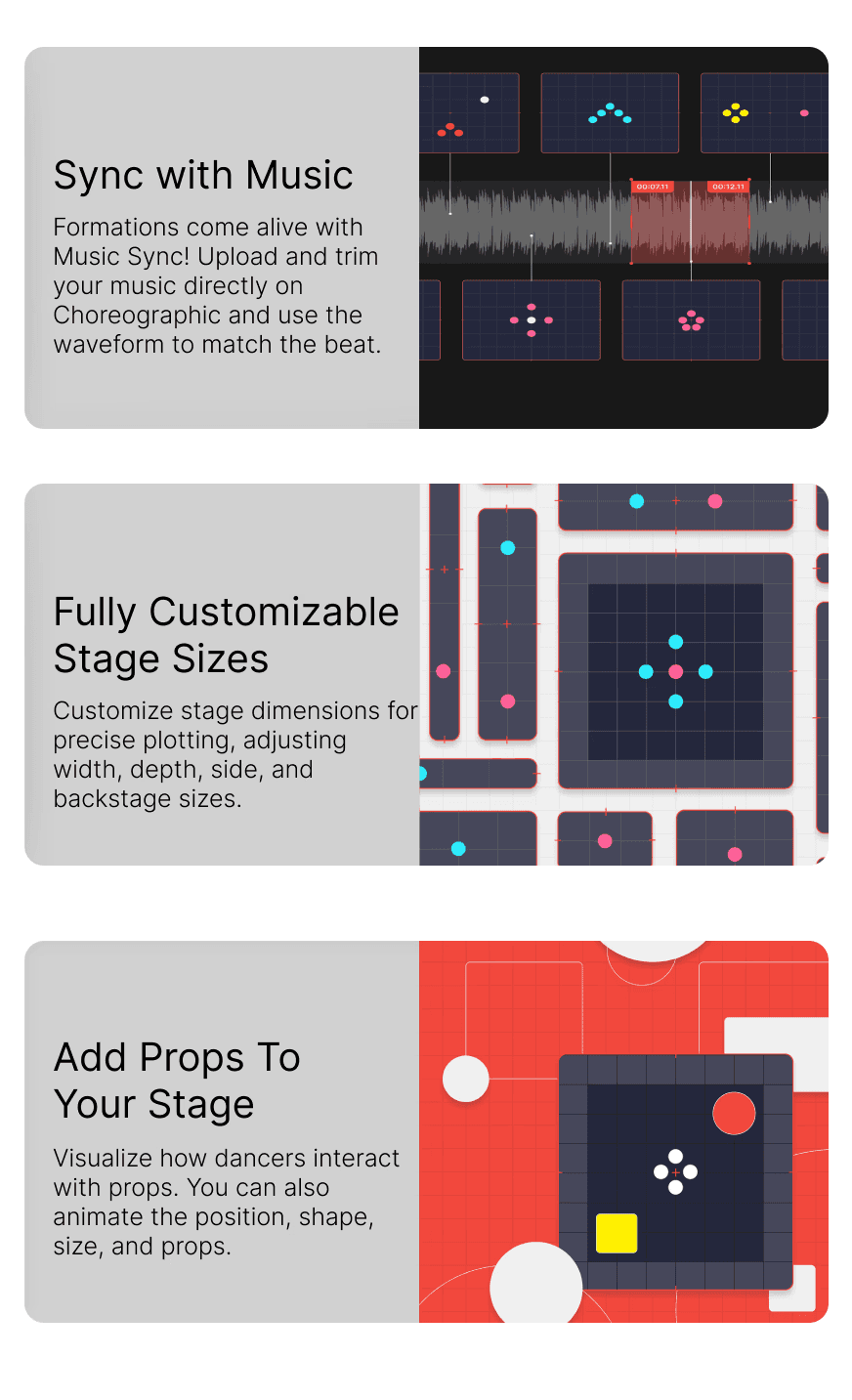
Calibrate the digital grid to match your physical performance space
Sync your team data to start plotting professional transitions
From creative intuition to intelligent spatial planning.
I transformed formation planning from manual spatial guesswork into an AI-assisted creative workflow enabling choreographers to generate, test, and adapt formations in real time.
The result: faster planning, fewer collisions, and confident large-scale performances without sacrificing artistic control.
Designing for Movement at Scale
Timeline
1 Week
My Role
Digital Product Designer
My Team
Tools
Figma
FigJam
Miro
Maze





CONTEXT
As dance productions scale in size and complexity, choreography remains constrained by manual spatial planning. What once worked for small crews now breaks under the weight of large formations, fast transitions, and tight rehearsal timelines urning creativity into a logistical bottleneck rather than a fluid process.
TOOL FOR THOUGHT
How might choreography systems think spatially, so creators can think creatively?
True creative flow emerges when tools anticipate constraints before they surface validating movement, space, and timing in real time. When systems shift from passive canvases to active collaborators, precision becomes effortless and rehearsal becomes exploration instead of correction.

TL;DR
Core Experience
Reimagining choreography planning with AI that turns complex spatial coordination into instant, collision-free formations reducing rehearsal friction while preserving full creative control.
WHAT
How does Choreographic work?
Why manual choreography systems can’t keep up with real-world performance demands?
Current choreography platforms act as passive canvases rather than intelligent collaborators. They store positions, but provide no predictive understanding of how formations evolve over time.
Without computational support, choreographers must:
• simulate movement mentally
• catch conflicts during rehearsal
• rebalance formations by trial and error
This shifts choreography from a design problem into a constant operational correction loop.
Key Problems Faced:
Problem Description:
No intelligent formation generation
Every spatial pattern must be built from scratch even when repeating known structures.
Zero predictive movement modeling
The system cannot foresee collisions, overlaps, or transition failures.
Complexity grows faster than human planning ability
Ten dancers are manageable. Fifty become cognitively overwhelming.
Late-stage error discovery
Problems surface only after physical rehearsal begins.
Creative bandwidth consumed by logistics
Time spent fixing spacing replaces time spent shaping performance.
Implementation of Generative AI
Implementation of Agentic AI
HOW
How will implementing AI transforms Choreographic
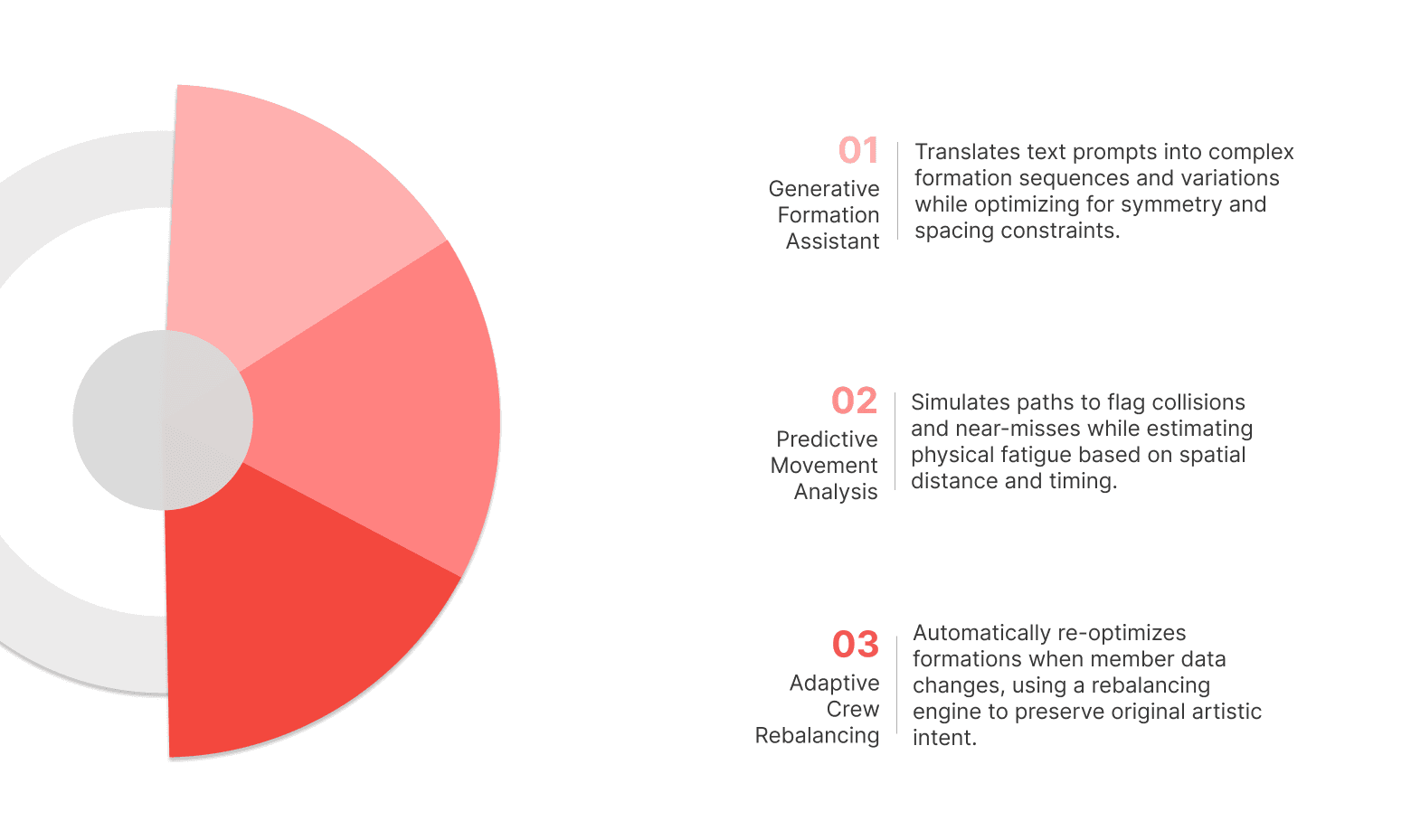
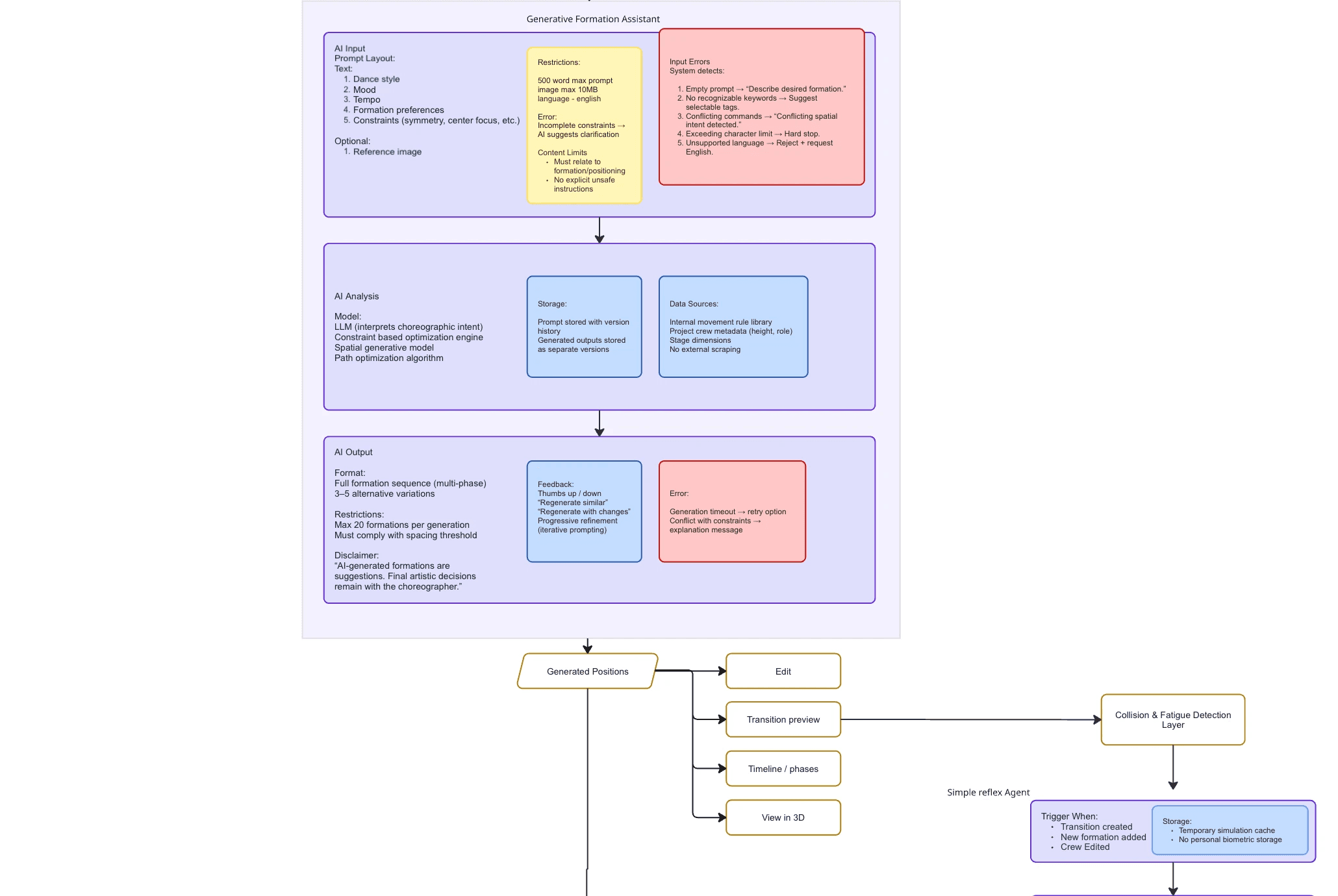
Transforms creative intent into structured dance formations and continuously monitors and improves choreography without manual commands.
Converts natural language prompts into spatial choreography
Generates multi-phase formation sequences
Produces 3–5 creative variations per prompt
Applies constraints like symmetry, spacing, tempo & focus
Alternative creative options & Ready-to-edit choreography sequences
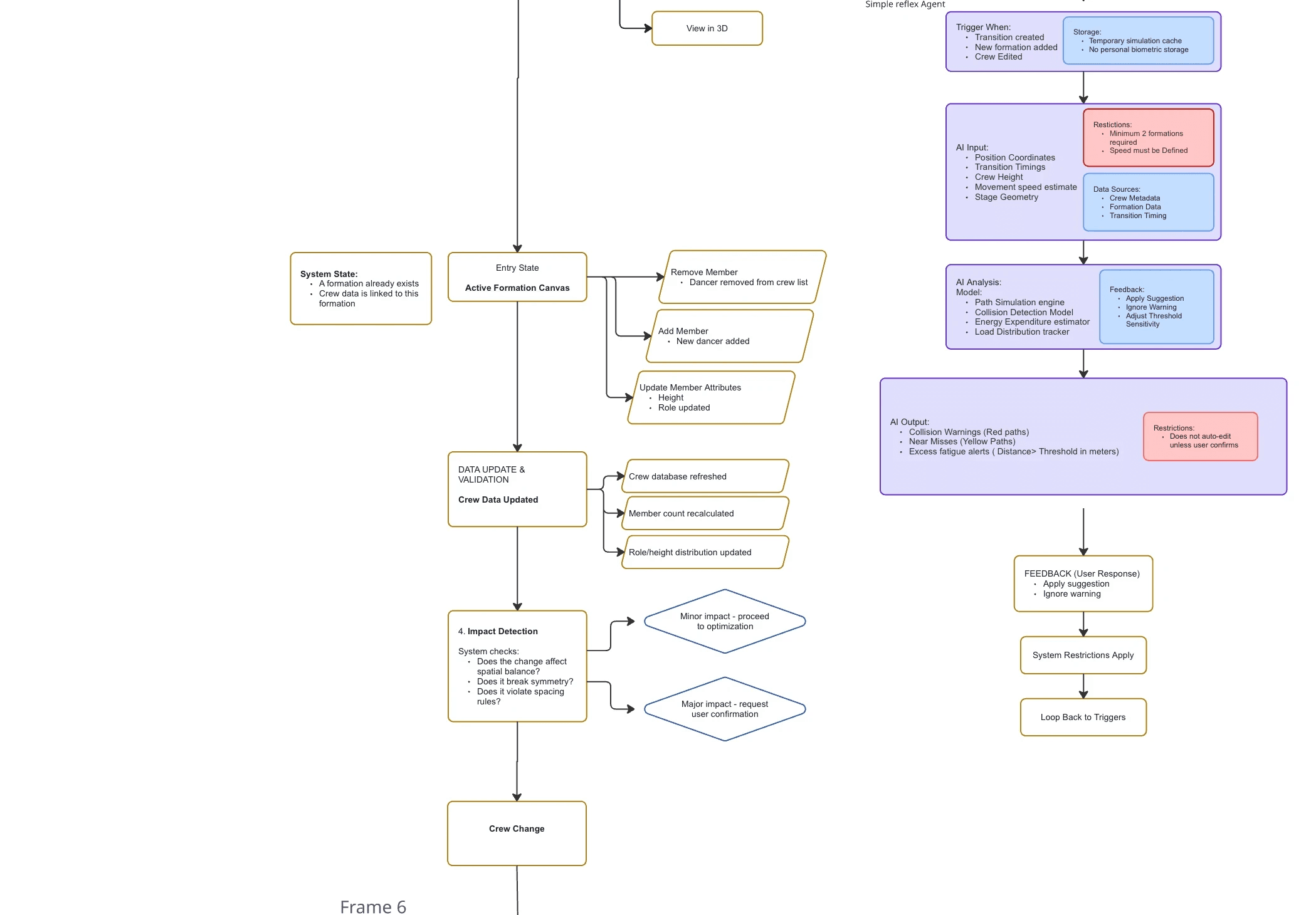
Detects collisions and fatigue risks automatically
Optimizes movement paths for safety
Rebalances formations after crew changes
Scores layout integrity and confidence
Escalates to user when uncertainty is high

To ground our design decisions in real user pain, we leveraged Claude as a structured research assistant to audit public usability feedback across app stores, forums, and community platforms.
We instructed the model to extract only real, verifiable negative experiences filtering out pricing concerns and transform them into a clean, Excel-ready dataset mapped across friction points, user goals, severity, and emotional impact.
This enabled rapid pattern clustering of recurring workflow breakdowns at scale, turning scattered qualitative feedback into actionable design insights.
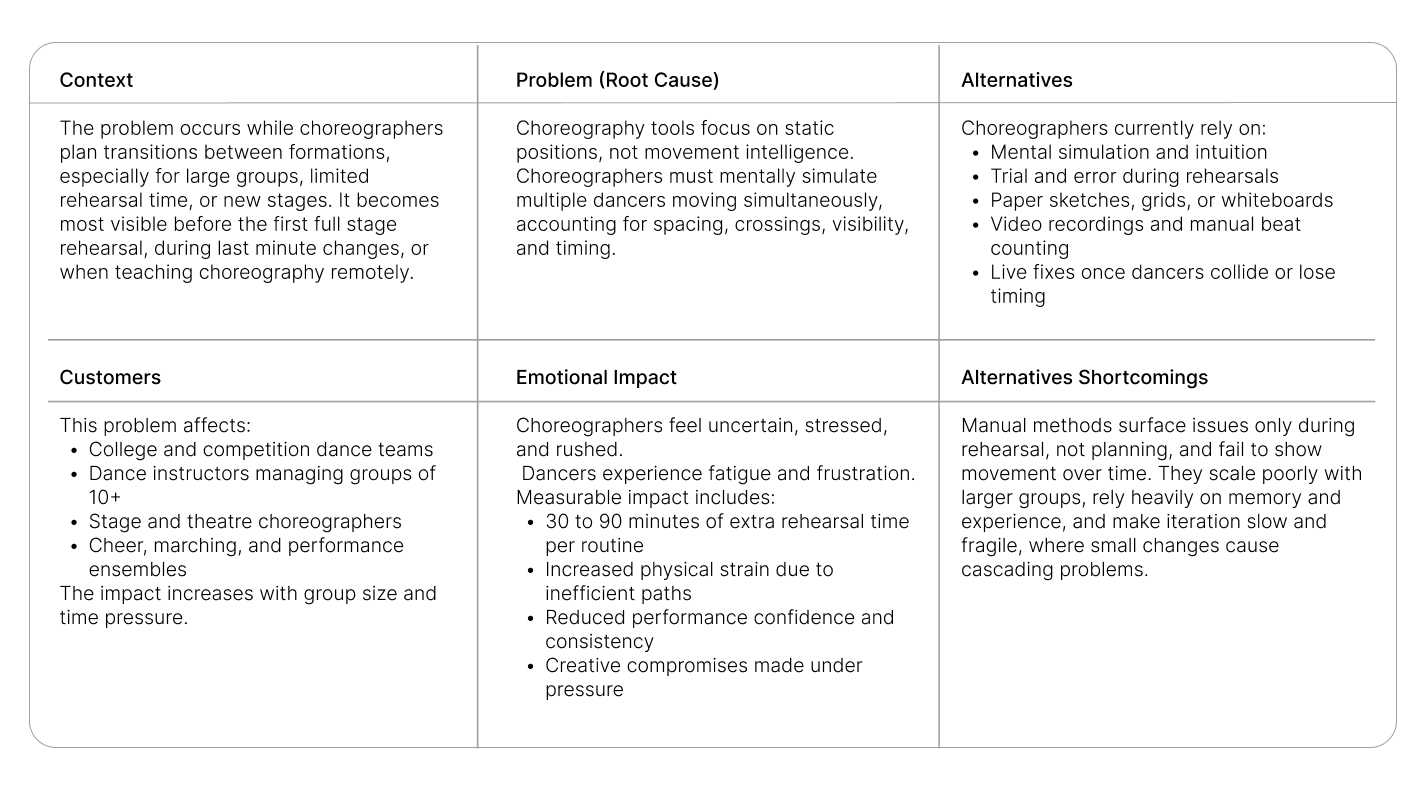
The friction map addresses how choreographers currently rely on stressful mental simulations and manual sketches that fail to account for movement intelligence, leading to collisions and wasted rehearsal time.
Friction Map
AI-powered Choreographic replaces stressful mental guesswork with predictive spatial intelligence, automating technical safety and stage mapping so you can focus entirely on your creative vision.
How will implementing AI transforms Choreographic
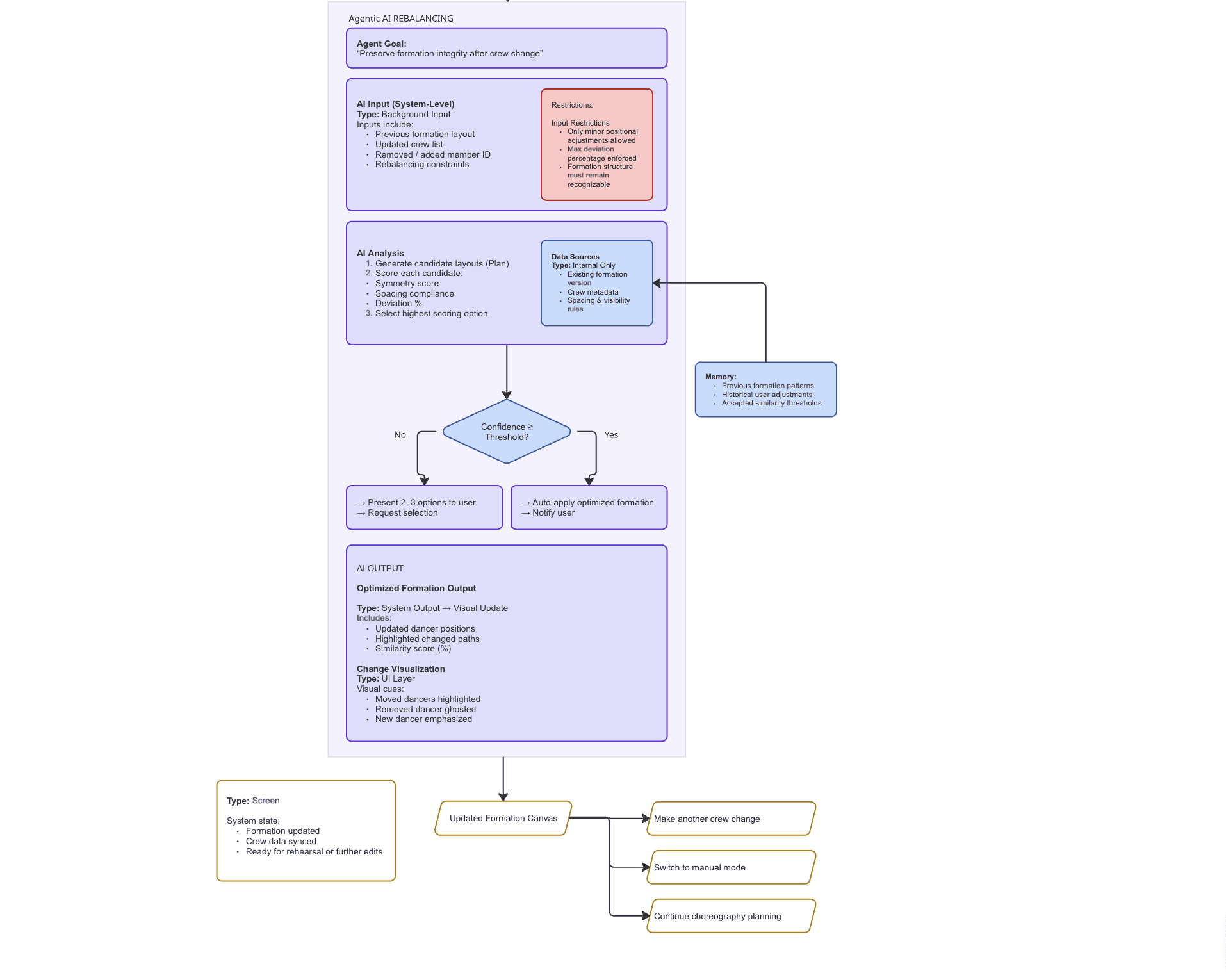
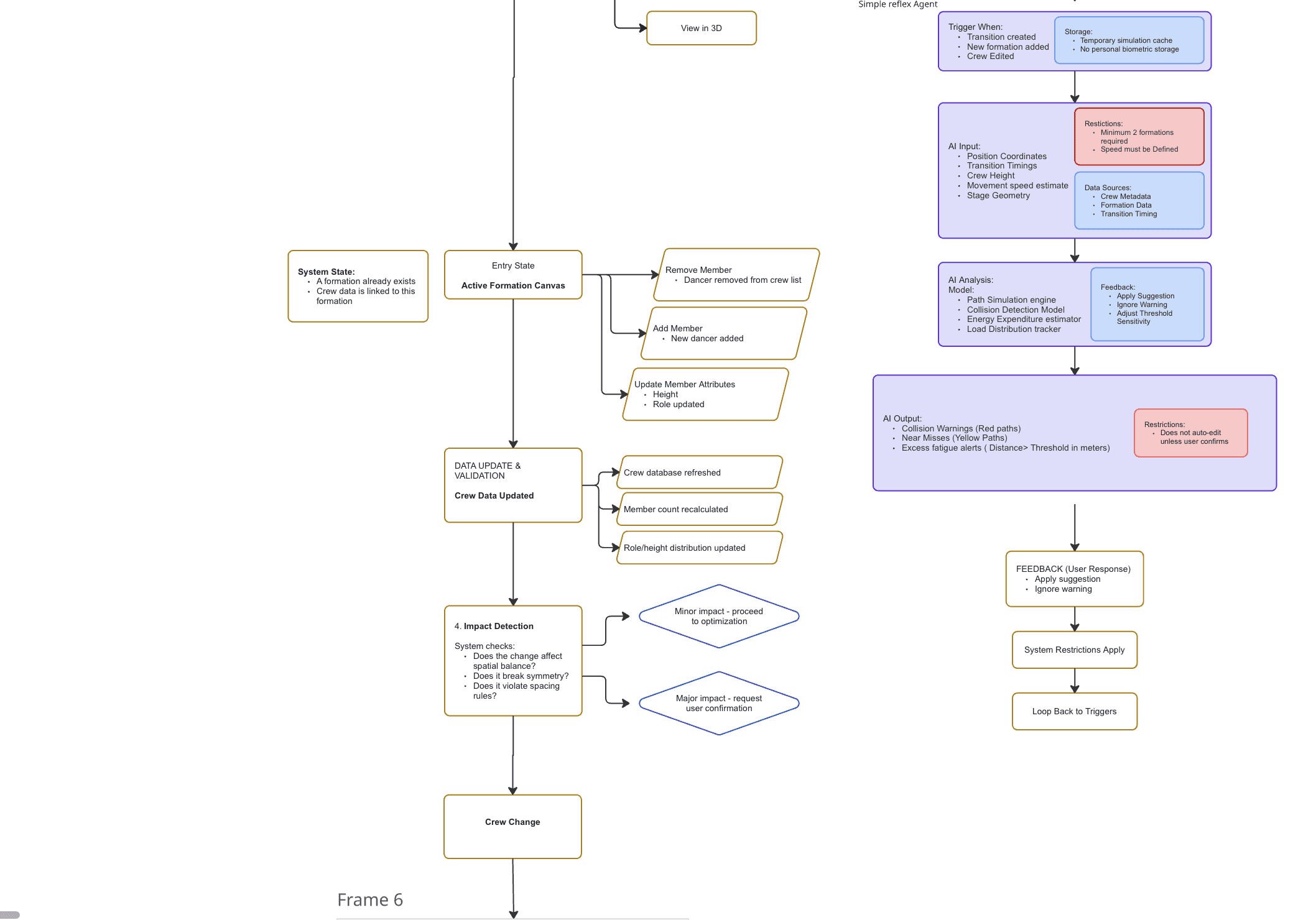
INFORMATION ARCHITECTURE
From creative intuition to intelligent structure.
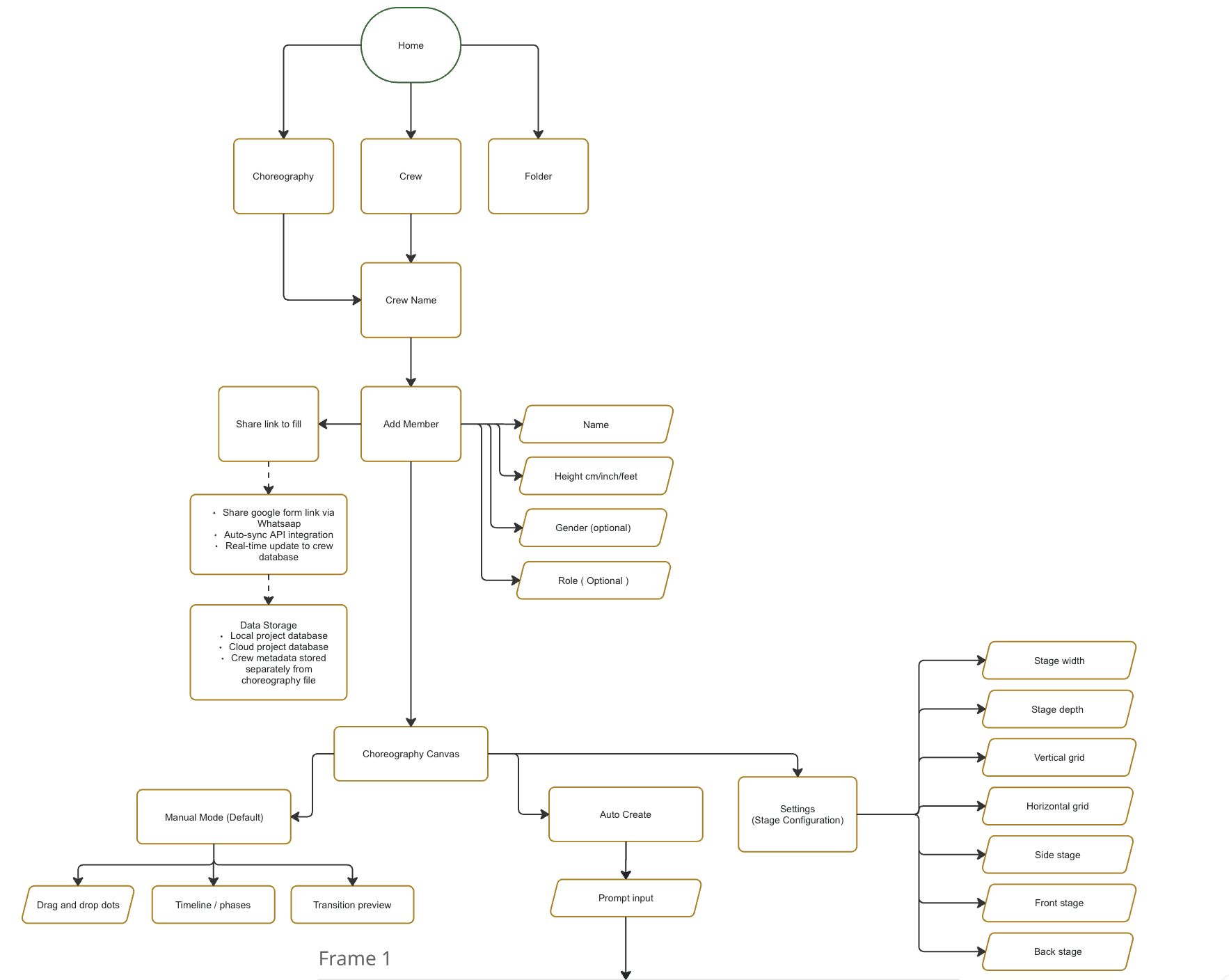
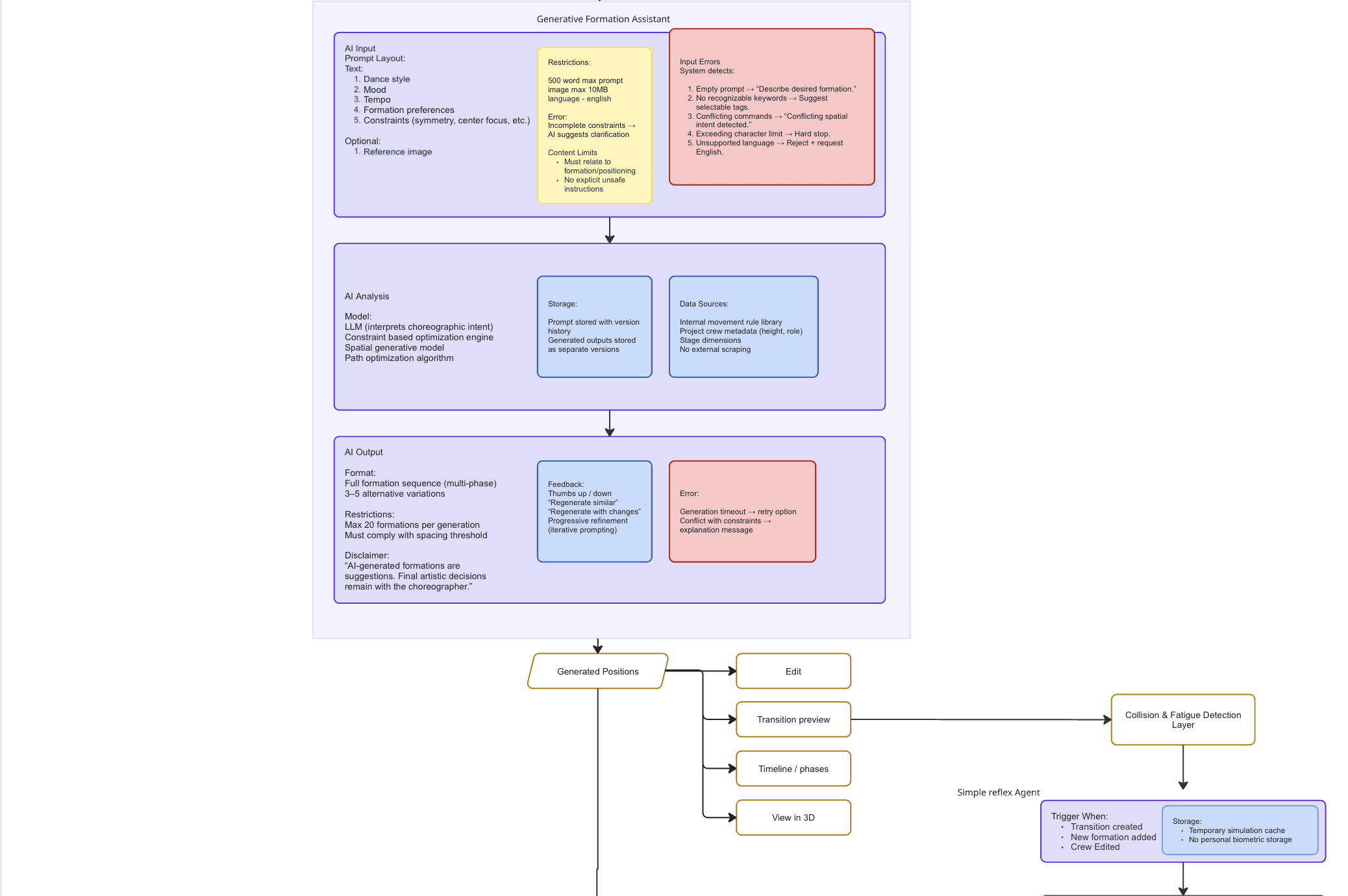
Before designing interfaces, mapped the full choreography workflow into a structured system of formations, crews, timing layers, and spatial rules creating a foundation where creativity could move faster without breaking down.
WIREFRAMES
Making Spatial thinking effortless by turning complexity into flow.
Once the system logic was defined, the challenge became making advanced spatial planning feel intuitive. Wireframes focused on enabling choreographers to think in motion visualizing formations, timing shifts, and transitions instantly, while AI handled precision, collisions, and balance in the background.
Reflection & Takeaways
Designing Choreographic taught me that creative tools shouldn’t demand attention they should protect flow.
Choreographers were spending energy solving spatial math instead of shaping emotion. The opportunity wasn’t to add features. It was to remove friction.
AI became the quiet partner validating formations, predicting collisions, and accelerating iteration without touching creative authorship.
The real takeaway:
The best intelligence is invisible.
The best tools feel effortless.
What's next?
The next phase of Choreographic evolves from a planning tool into an intelligent creative partner. AI will learn individual choreographers’ styles, optimize formations for visibility and symmetry in real time, and simulate full routines before dancers ever step on stage. With predictive spacing, adaptive timing, and generative pattern exploration, the platform will move beyond execution into inspiration accelerating ideation while preserving artistic control.
Choreographic’s future isn’t just about arranging dancers.
It’s about designing movement at the speed of thought.
Glad we could cross paths!
I hope it left you with a bit of curiosity and inspiration.
LET'S CONNECT!
+91 96000 95584
PROBLEM SPACE
Why does choreography break down as routines scale in complexity?
Choreographic reframes choreography as spatial composition.
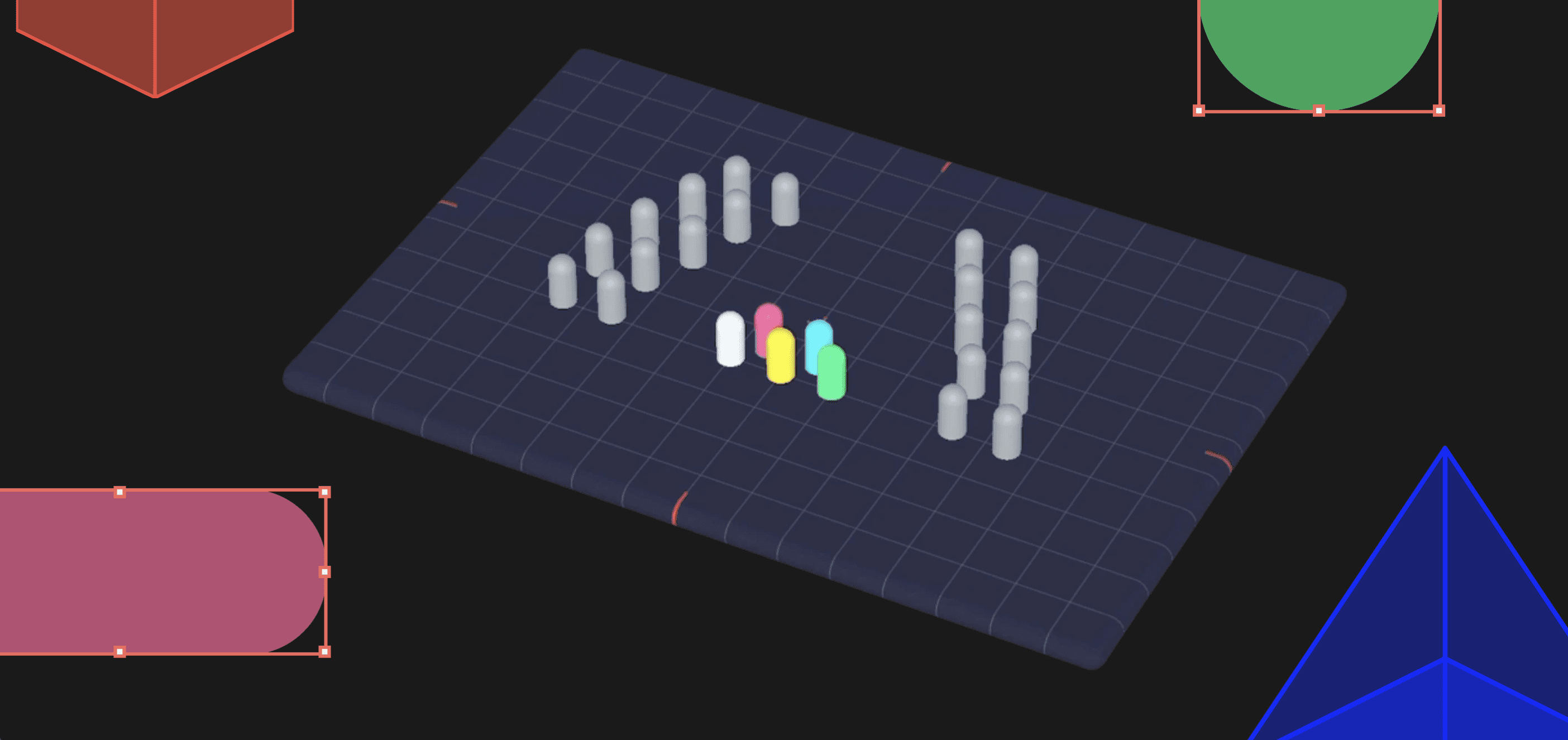
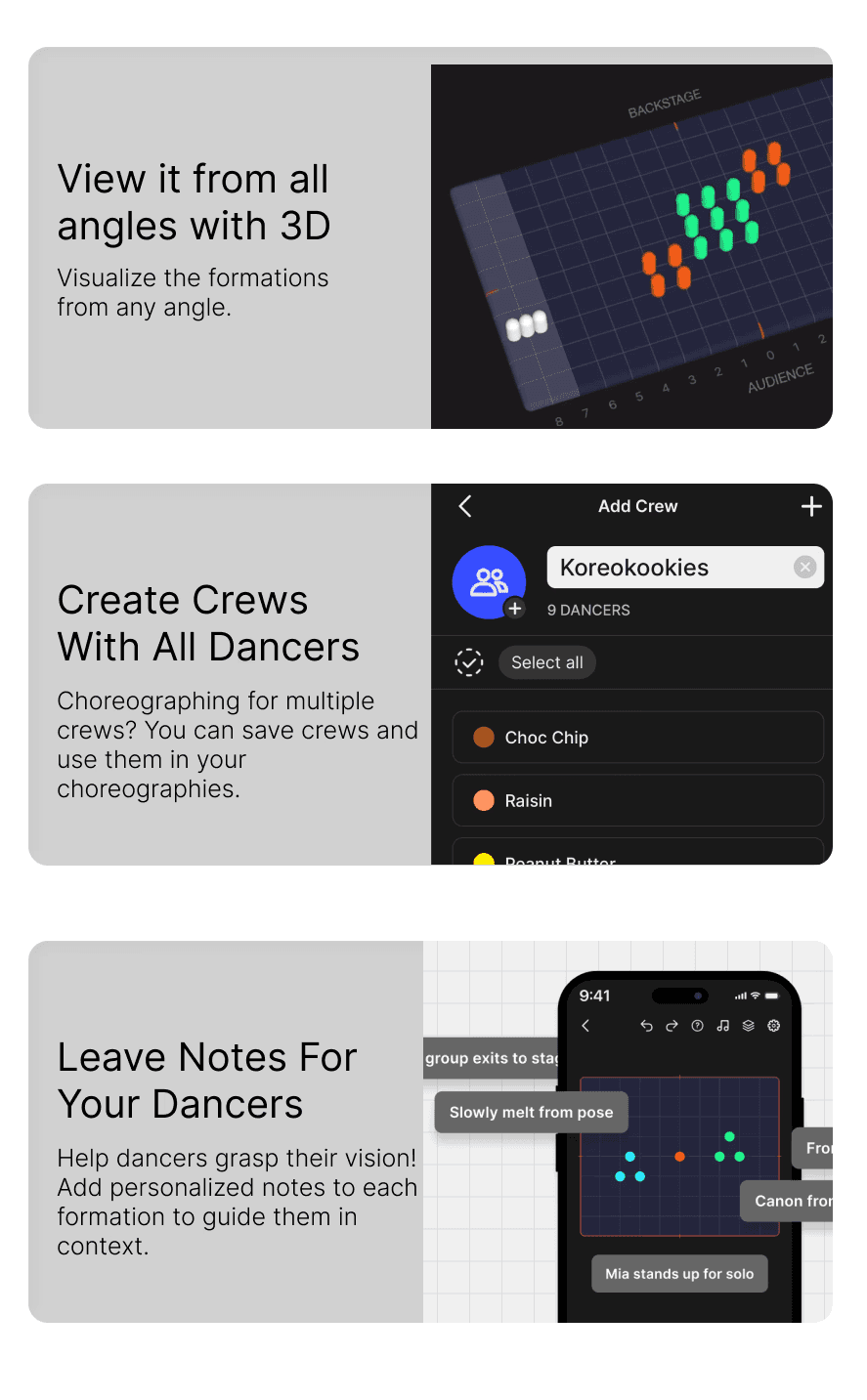
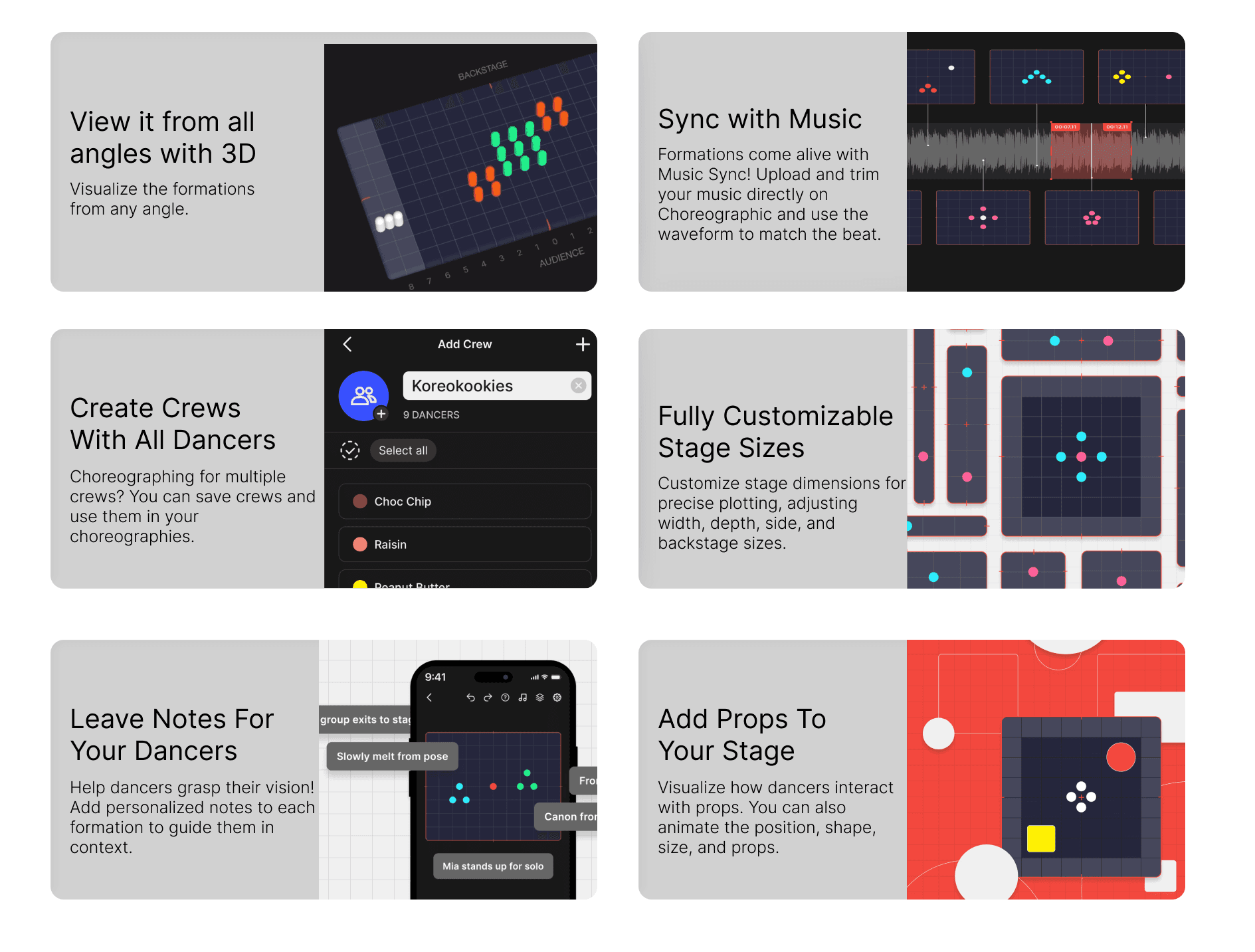
It enables choreographers to design formations in 3D, orchestrate timing to music, and move dancers through fluid, conflict-free motion.
I transformed formation planning from manual spatial guesswork into an AI-assisted creative workflow enabling choreographers to generate, test, and adapt formations in real time.
The result: faster planning, fewer collisions, and confident large-scale performances without sacrificing artistic control.
Timeline
1 Week
My Team
My Role
Digital Product Designer
Tools
Figma
FigJam
Miro
Maze
Designing for Movement at Scale
From creative intuition to intelligent spatial planning.
Friction Map
The friction map addresses how choreographers currently rely on stressful mental simulations and manual sketches that fail to account for movement intelligence, leading to collisions and wasted rehearsal time.
What's next?
The next phase of Choreographic evolves from a planning tool into an intelligent creative partner. AI will learn individual choreographers’ styles, optimize formations for visibility and symmetry in real time, and simulate full routines before dancers ever step on stage. With predictive spacing, adaptive timing, and generative pattern exploration, the platform will move beyond execution into inspiration accelerating ideation while preserving artistic control.
Choreographic’s future isn’t just about arranging dancers.
It’s about designing movement at the speed of thought.
As dance productions scale in size and complexity, choreography remains constrained by manual spatial planning. What once worked for small crews now breaks under the weight of large formations, fast transitions, and tight rehearsal timelines urning creativity into a logistical bottleneck rather than a fluid process.
CONTEXT
TOOL FOR THOUGHT
How might choreography systems think spatially, so creators can think creatively?
True creative flow emerges when tools anticipate constraints before they surface validating movement, space, and timing in real time. When systems shift from passive canvases to active collaborators, precision becomes effortless and rehearsal becomes exploration instead of correction.
TL;DR
Reimagining choreography planning with AI that turns complex spatial coordination into instant, collision-free formations reducing rehearsal friction while preserving full creative control.
Core Experience
Designing Movement at Scale
From creative intuition to intelligent spatial planning.
I transformed formation planning from manual spatial guesswork into an AI-assisted creative workflow enabling choreographers to generate, test, and adapt formations in real time.
The result: faster planning, fewer collisions, and confident large-scale performances without sacrificing artistic control.
HOW
Transforms creative intent into structured dance formations and continuously monitors and improves choreography without manual commands.
How will implementing AI transforms Choreographic
Detects collisions and fatigue risks automatically
Optimizes movement paths for safety
Rebalances formations after crew changes
Scores layout integrity and confidence
Escalates to user when uncertainty is high
Implementation of Agentic AI
Converts natural language prompts into spatial choreography
Generates multi-phase formation sequences
Produces 3–5 creative variations per prompt
Applies constraints like symmetry, spacing, tempo & focus
Alternative creative options & Ready-to-edit choreography sequences
Implementation of Generative AI
WHAT
How does Choreographic work?
INFORMATION ARCHITECTURE
Before designing interfaces, mapped the full choreography workflow into a structured system of formations, crews, timing layers, and spatial rules creating a foundation where creativity could move faster without breaking down.
From creative intuition to intelligent structure.
Designing Choreographic taught me that creative tools shouldn’t demand attention they should protect flow.
Choreographers were spending energy solving spatial math instead of shaping emotion. The opportunity wasn’t to add features. It was to remove friction.
AI became the quiet partner validating formations, predicting collisions, and accelerating iteration without touching creative authorship.
The real takeaway:
The best intelligence is invisible.
The best tools feel effortless.
Reflection & Takeaways
How will implementing AI transforms Choreographic
AI-powered Choreographic replaces stressful mental guesswork with predictive spatial intelligence, automating technical safety and stage mapping so you can focus entirely on your creative vision.
Timeline
3 Days
My Team
Sanchita Thiagarajan
Saidiya K C
Rinitha Biju Thomas
Nikitha Thirumurugan
Reny Dennis
My Role
Digital Product
Designer
Tools
Figma
FigJam
Miro
Maze
Glad we could cross paths!
I hope it left you with a bit of curiosity and inspiration.
LET'S CONNECT!
+91 96000 95584
Choreographic reframes choreography as spatial composition.
It enables choreographers to design formations in 3D, orchestrate timing to music, and move dancers through fluid, conflict-free motion.
Why does choreography break down as routines scale in complexity?
To ground our design decisions in real user pain, we leveraged Claude as a structured research assistant to audit public usability feedback across app stores, forums, and community platforms.
We instructed the model to extract only real, verifiable negative experiences filtering out pricing concerns and transform them into a clean, Excel-ready dataset mapped across friction points, user goals, severity, and emotional impact.
This enabled rapid pattern clustering of recurring workflow breakdowns at scale, turning scattered qualitative feedback into actionable design insights.
View structured dataset → Excel link
Choreographic
Problem Description:
Key Problems Faced:
Why manual choreography systems can’t keep up with real-world performance demands?
Current choreography platforms act as passive canvases rather than intelligent collaborators. They store positions, but provide no predictive understanding of how formations evolve over time.
Without computational support, choreographers must:
• simulate movement mentally
• catch conflicts during rehearsal
• rebalance formations by trial and error
This shifts choreography from a design problem into a constant operational correction loop.
No intelligent formation generation
Every spatial pattern must be built from scratch even when repeating known structures.
Zero predictive movement modeling
The system cannot foresee collisions, overlaps, or transition failures.
Complexity grows faster than human planning ability
Ten dancers are manageable. Fifty become cognitively overwhelming.
Late-stage error discovery
Problems surface only after physical rehearsal begins.
Creative bandwidth consumed by logistics
Time spent fixing spacing replaces time spent shaping performance.